

Fake reviews look like a shortcut. A handful of five-star ratings, a polished average score, and suddenly your business looks more credible than it actually is. The problem is that understanding why Google penalizes fake reviews is not just academic. Google's detection systems have matured to the point where the consequences of getting caught now far outweigh any short-term boost you might see. This guide breaks down exactly how Google catches fake reviews, what happens when it does, and how to build a review profile that actually holds up over time.
Table of Contents
- Key takeaways
- Why Google penalizes fake reviews
- How Google detects fake reviews
- Consequences and penalties for fake reviews
- Common violations and 2026 policy updates
- How to avoid review penalties
- What to do if you are penalized
- My take on why businesses keep getting this wrong
- Build a review profile that actually lasts
- FAQ
Key takeaways
| Point | Details |
|---|---|
| Google blocks most fakes early | Over 85% of fake reviews are blocked or removed before they ever go live. |
| Behavioral signals trigger detection | Device clustering, IP patterns, and review velocity spikes expose fake campaigns faster than text filters alone. |
| Penalties go beyond review removal | Businesses face profile suspensions, ranking drops, and FTC fines up to $53,088 per violation. |
| 2026 policies closed common loopholes | In-store kiosks, shared tablets, and incentivized reviews are now explicitly prohibited under updated Google rules. |
| Authentic growth is the only safe path | Steady, verified reviews from real customers protect your reputation and survive algorithm updates. |
Why Google penalizes fake reviews
Google's entire local search product depends on one thing: trust. When a user searches for a plumber, a restaurant, or a dentist, they rely on ratings to make a real decision. If those ratings are manufactured, Google's product fails. That is the core reason why Google penalizes fake reviews. It is not punitive for the sake of it. Google is protecting the integrity of a system that billions of people use every day.
The impact of fake reviews extends beyond individual businesses. When fake ratings flood a category, legitimate businesses with real customer feedback get buried. Consumers make worse decisions. Over time, users stop trusting the platform. Google has a direct financial incentive to prevent that outcome, which is why its enforcement has become progressively more aggressive.
Google review policies have always prohibited manufactured or misleading content, but the enforcement mechanisms have changed dramatically. Early systems relied heavily on text pattern matching. Modern systems go much deeper, analyzing the full behavioral context around every review submitted.
How Google detects fake reviews
Google does not just read a review. It builds a behavioral profile around it. Automated enforcement models analyze review clusters using hardware hashes, account trust scores, and network behavior to identify fraud before a single review goes public.
Here is what actually triggers detection:
- Review velocity spikes. A business that receives two reviews a month suddenly getting forty in a week is a red flag. The system flags the burst and examines every account involved.
- Device fingerprint clustering. When multiple reviews come from the same device or a tight cluster of devices on the same IP subnet, behavioral forensic triggers fire immediately.
- Account trust scores. New accounts with no activity history that suddenly post a five-star review carry almost no weight and are more likely to be filtered out.
- Templated or repetitive language. Reviews that share phrasing structures across different accounts get flagged for coordinated behavior.
- Network behavior patterns. Google maps relationships between reviewer accounts. If a group of accounts only ever reviews the same set of businesses, that pattern is detectable.
The shift from text-based analysis to behavioral forensics is what makes modern fake review campaigns so difficult to sustain. You can spin up a hundred new accounts with unique text. You cannot easily fake independent device histories, organic account activity, and geographically diverse IP addresses all at once.
Pro Tip: If you are auditing your own review profile and notice a sudden spike you did not generate, document it immediately. That documentation becomes your evidence if you need to report competitor manipulation later.
Consequences and penalties for fake reviews
The penalties for fake reviews are not just a slap on the wrist. They span a spectrum from automated review removal all the way to federal enforcement actions.

| Penalty type | What happens | Who enforces it |
|---|---|---|
| Review removal | Individual fake reviews are deleted, often silently | Google automated systems |
| Rating suppression | Star average drops or becomes temporarily hidden | Google automated systems |
| Profile suspension | Your entire Google Business Profile is suspended | Google enforcement team |
| Ranking impact | Local search visibility drops significantly | Google algorithm |
| FTC civil penalty | Up to $53,088 per violation | Federal Trade Commission |
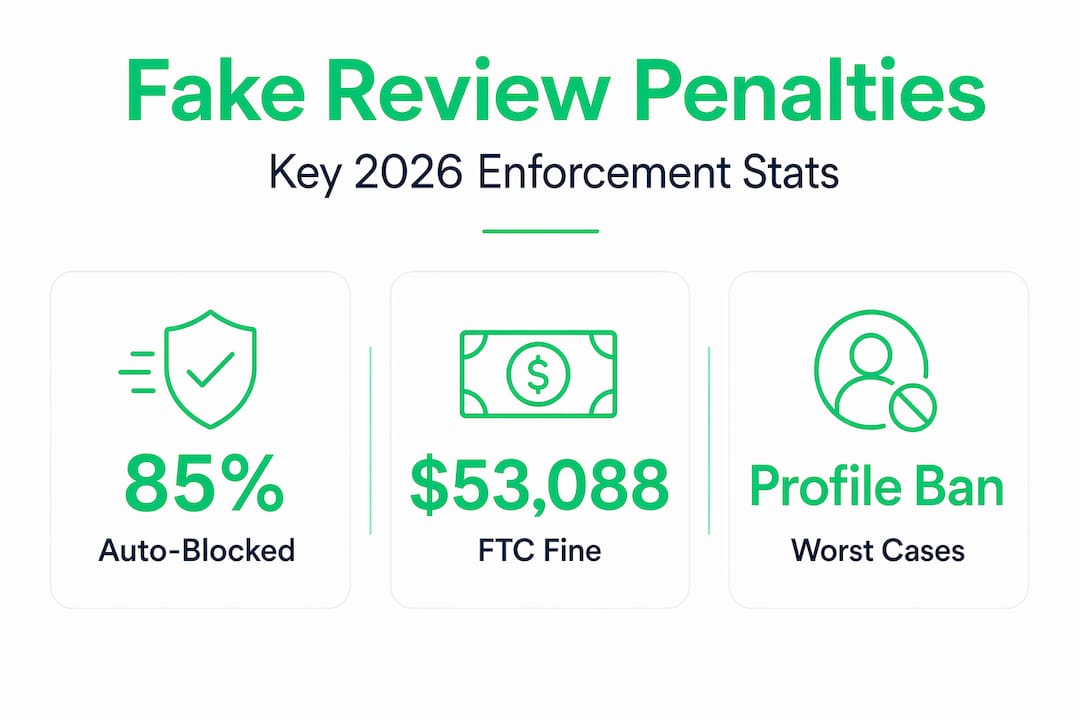
The FTC angle is one most business owners do not think about. As of January 2025, the agency can impose maximum civil penalties of $53,088 per fake review violation, and in December 2025 it warned ten companies about possible violations of its Consumer Review Rule. That is not a theoretical risk anymore.
Beyond the financial exposure, the long-term damage to brand trust is often worse than any fine. Customers who discover a business has been manufacturing reviews do not just leave. They tell others. They post screenshots. The reputational fallout from getting caught publicly is almost impossible to recover from quickly.
"The false economy of fake reviews is that you pay twice: once to get them, and again when they cost you everything you built."
It is also worth understanding the difference between automated removals and broader enforcement actions. Google suppresses review-farmed or incentivized reviews through delays, visibility drops, and profile suspensions depending on severity. Automated removal is quiet and fast. A full enforcement action involves human review and can result in permanent profile loss.
Common violations and 2026 policy updates
Google's updated policies for 2026 have closed several gray areas that businesses previously exploited. Knowing what is now explicitly prohibited keeps you out of trouble.
- Paid or incentivized reviews. Offering discounts, free products, or cash in exchange for reviews is prohibited. Incentivized review campaigns trigger enforcement at rates between 92% and 97% as of 2024.
- In-store review kiosks and shared tablets. This is a major 2026 change. Google's updated rules now explicitly prohibit using shared devices in your store to collect reviews. The concern is that reviews submitted this way are coerced or lack genuine independence.
- Employee and owner reviews. Posting reviews of your own business, or having employees do it, violates conflict-of-interest rules regardless of whether the reviewer is a real customer.
- Bot-generated or purchased reviews. Buying reviews from third-party services is the most obvious violation and the easiest for Google to detect through account clustering.
- Review gating. Filtering customers and only asking happy ones to leave reviews while discouraging negative feedback is a policy violation, even if no fake reviews are involved.
The kiosk prohibition catches many small businesses off guard. If you have been using an iPad at your front desk to collect reviews, that practice is now a direct violation of Google review policies. The fix is to send review requests digitally after the customer has left your premises.
How to avoid review penalties
Building a compliant review profile is not complicated, but it does require consistency. Here is a practical approach that holds up under Google's current enforcement standards.
- Ask every customer, not just happy ones. Review gating is a policy violation. Send review requests to all customers after a transaction and let the responses be genuine.
- Use post-visit digital requests. Send requests by text or email after the customer has left. This removes any in-person pressure and satisfies the independence requirement in Google's 2026 policies.
- Document your outreach process. Keep records of who you asked and when. If Google ever flags your profile, this documentation supports your case.
- Report suspicious competitor reviews with evidence. Effective flags require detailed evidence proving reviewers are not genuine customers, cross-referenced against your business records. Vague reports rarely result in removal.
- Respond professionally to every negative review. A calm, factual response protects your reputation publicly. It does not affect your flagging request, but it shapes how future customers perceive the situation.
- Monitor your review velocity. If you run a promotion and suddenly get a surge of reviews, that is fine as long as they are real. But be aware that the spike will attract algorithmic scrutiny, so make sure your outreach is documented.
Pro Tip: Tools like Excelrate send review requests via QR code after a customer visit, keeping the process compliant and the feedback genuine. Low-star responses get routed to private feedback instead of going public, which is fully within Google's policies.
What to do if you are penalized
Getting flagged or penalized is not the end, but your response matters. Here is how to handle it.
- Read the removal notice carefully. Google's notices specify which policy was violated. Understanding the exact reason tells you whether you are dealing with an automated filter or a human enforcement action.
- Build a documented case. Cross-reference customer records and document every legitimate review you can verify. If real reviews were caught in a false positive, this evidence supports your appeal.
- Submit a reinstatement request with specifics. Generic appeals fail. Provide transaction records, customer contact logs, and a clear explanation of your review solicitation process.
- Do not retaliate. Responding to a penalty by buying negative reviews for competitors or flooding your own profile with new reviews accelerates enforcement and adds new violations.
- Set realistic timelines. Recovery from a profile suspension can take weeks. Rebuilding a review profile after enforcement takes months of consistent, authentic activity.
Google's systems sometimes produce false positives that remove legitimate reviews accidentally. If you have been running a clean operation and still get flagged, the appeal process exists for exactly this reason. Document everything and stay patient.
My take on why businesses keep getting this wrong
I've watched businesses make the same mistake for years. They see a competitor with 200 reviews and panic. They think buying fifty reviews will close the gap. What they are actually doing is building on sand.
Here is what I've learned: the businesses that get hurt worst by Google's enforcement are not the ones that made one bad decision. They are the ones that made a small bad decision, saw it work briefly, and then scaled it. By the time the penalty hits, they have a profile full of fake reviews that cannot be defended and a real review count that is too low to recover quickly.
The behavioral forensics Google uses now mean that shortcuts fail over time, not immediately. That delay is the trap. A campaign that looks like it worked for three months can still trigger a retroactive enforcement action when Google's models catch up to the pattern.
What actually works is boring and consistent. Ask real customers. Make it easy. Send a follow-up. Route unhappy customers to private feedback so you can fix the problem before it becomes a public one-star review. The businesses I've seen build genuinely strong review profiles treat review collection as a customer service process, not a marketing tactic.
The review ecosystem is shifting toward authenticity not because Google is idealistic, but because its AI is good enough now to tell the difference. That is a permanent change, not a phase.
— Spencer
Build a review profile that actually lasts
If this article has made one thing clear, it is that the consequences of fake reviews are not worth the risk. Excelrate was built specifically to help small businesses collect authentic Google reviews the right way. Using QR codes placed at the point of service, Excelrate sends review requests after the customer has left, keeping the process independent and compliant with Google's 2026 policies.
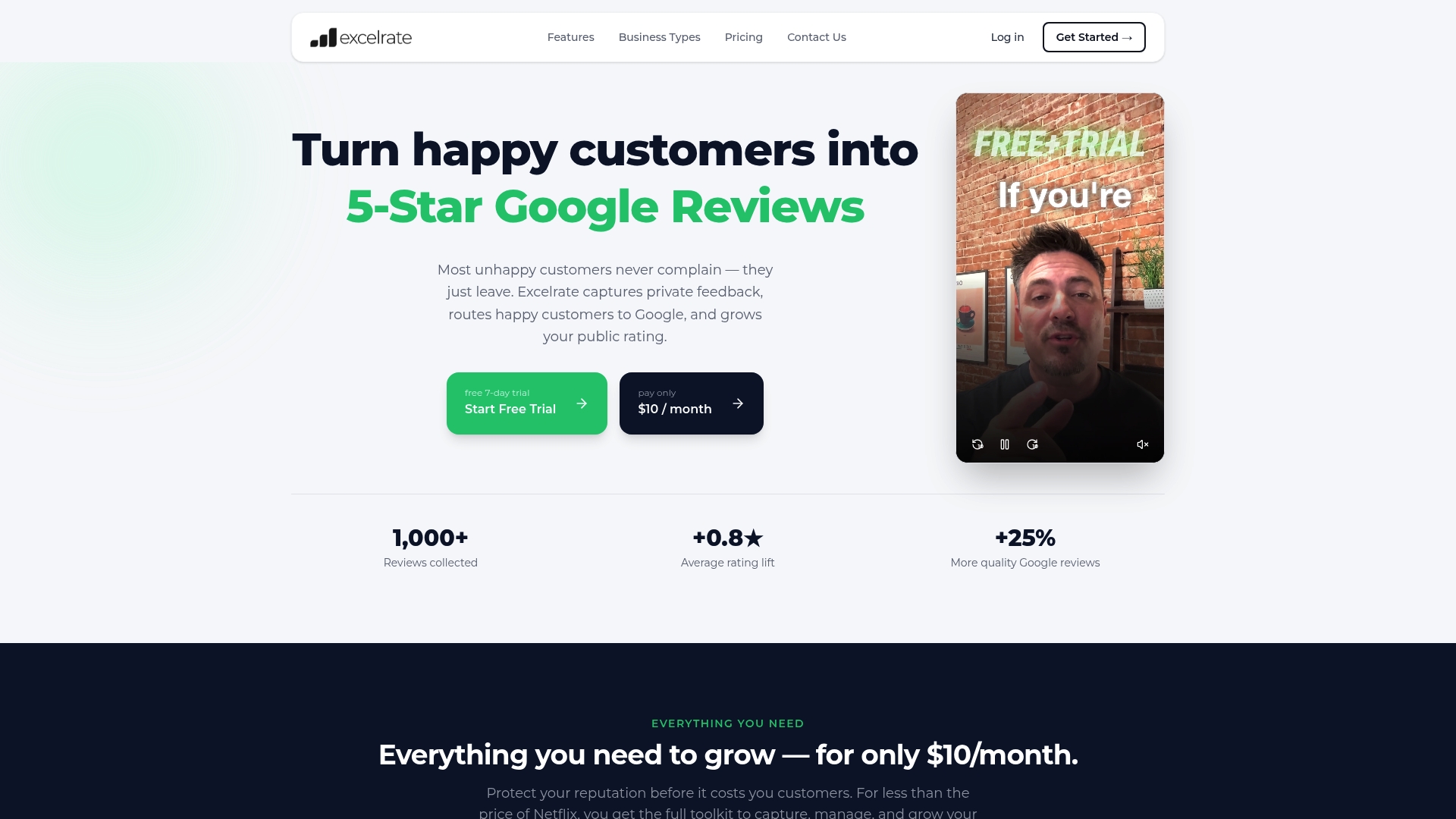
Low-star responses get routed to private feedback before they go public, so you can address problems directly without losing your rating. Whether you run a restaurant or bar, a retail shop, or a home services business, Excelrate gives you the tools to grow your reputation without shortcuts. Plans start at $10 per month, making it one of the most practical investments you can make in your online presence.
FAQ
Why does Google penalize fake reviews?
Google penalizes fake reviews to protect consumer trust and the integrity of its local search product. When ratings are manufactured, users make worse decisions and the platform loses credibility.
Can fake reviews get my Google Business Profile suspended?
Yes. Depending on the severity and scale of the violation, Google can suspend your entire Business Profile, not just remove individual reviews.
What are the FTC penalties for fake reviews?
The FTC can impose civil penalties up to $53,088 per fake review violation under its Consumer Review Rule, which took effect in January 2025.
Are in-store review kiosks allowed in 2026?
No. Google's 2026 policy updates explicitly prohibit using shared tablets or in-store kiosks to collect reviews, as these practices can result in coerced or non-independent feedback.
How do I report fake reviews left by a competitor?
Document evidence that the reviewers are not genuine customers by cross-referencing your business records, then submit a detailed flag through Google Business Profile. Vague reports are rarely acted on. Specific, evidence-based flags reach human moderators and are far more likely to result in removal.